
Weatherproof Solutions for High-Impact Outdoor Branding
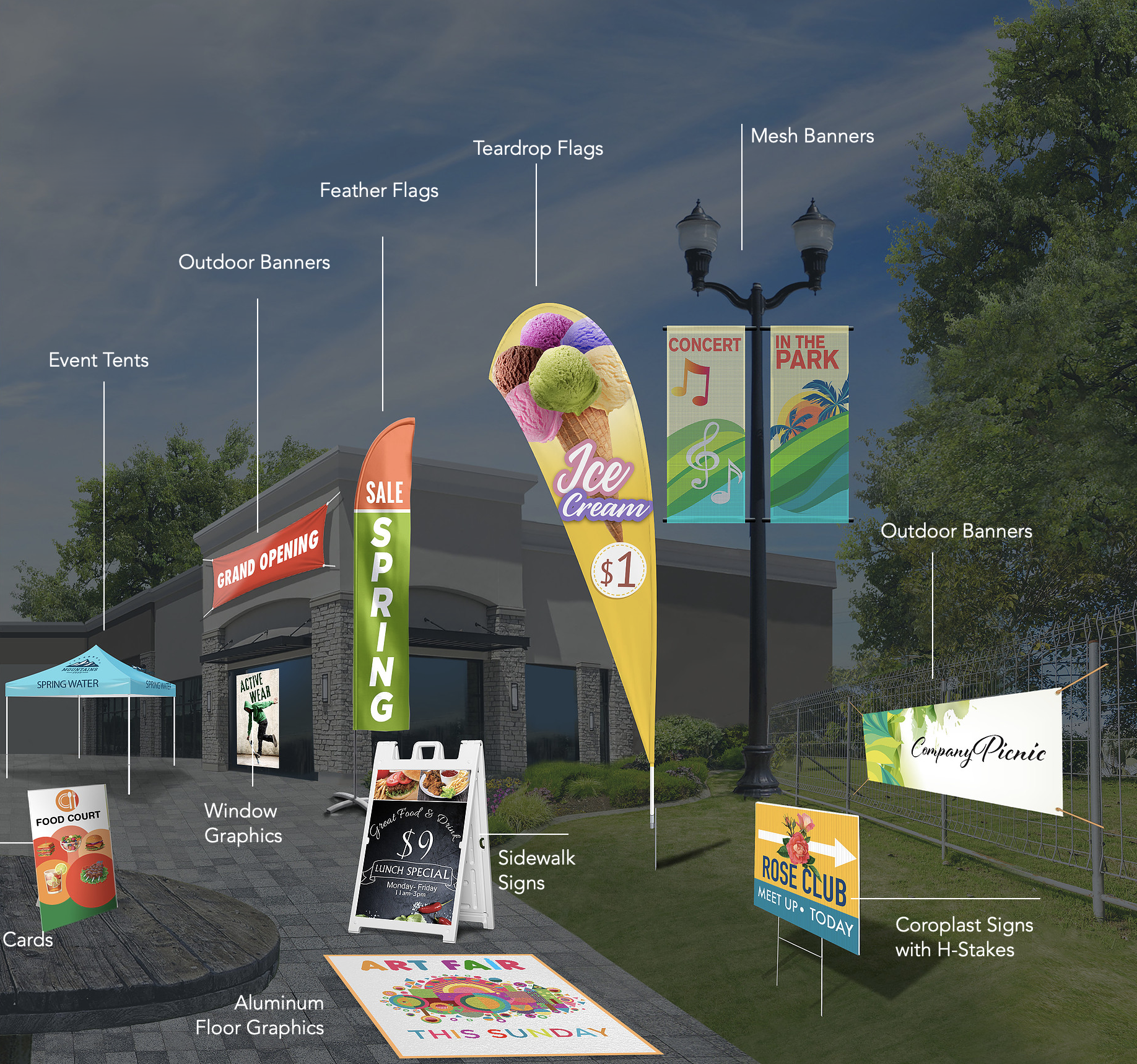
Your outdoor signs are the hardest working assets in your local marketing toolkit. They stand on the curbside or hang from your storefront twenty-four hours a day, seven days a week, introducing your business to every driver and pedestrian who passes by. However, the outdoor environment is incredibly hostile. Intense UV rays, heavy downpours, and relentless wind can turn a beautiful marketing investment into a faded, torn piece of trash in just a few months.
When a client sees a warped yard sign or a ripped banner hanging from a fence, they instantly associate that neglect with the quality of your services. Choosing the wrong substrate doesn’t just waste your print budget, it actively damages your brand image. This guide breaks down the engineering behind durable outdoor materials so you can choose options that last.
Wind and Rain: Why Standard Vinyl Banners Fail Outdoors
Many business owners order standard, solid vinyl banners for outdoor fences or building facades because they look great indoors. This is an expensive mistake. A solid piece of vinyl acts exactly like a ship sail when the wind picks up. It traps the air, putting eye-watering pressure on the grommets, zip ties, and the structure holding the sign up. Over a few windy weeks, the holes will rip open or the entire banner will tear in half.
The Mesh Banner Advantage
If you are hanging a sign on a chain-link fence, construction site, or between light poles, skip solid vinyl. You need perforated mesh banners.
Mesh banners are woven with thousands of tiny holes that allow wind to pass right through the material. This drastically reduces wind load, preventing the banner from turning into a sail and ripping itself apart.
Don’t worry about losing your image quality. Advanced print setups apply vibrant, high-density ink that bridges these tiny gaps. From a few feet away, the human eye blends the holes together, leaving nothing but a crisp, highly visible advertisement.
Capturing Attention Through Movement: Feather and Teardrop Flags
Static signs can easily blend into the background after a customer passes them every day on their morning commute. To break through that visual fatigue, you need to introduce dynamic movement.
Feather flags and teardrop flags use flexible fiberglass poles and lightweight polyester fabrics to catch the slightest breeze. Instead of resisting the wind, they dance with it, creating a fluid motion that naturally draws the human eye from a distance.
- Feather Flags: Excellent for long vertical text like “SALE”, “OPEN”, or “SPRING”. They offer a larger square layout for text readability from the road.
- Teardrop Flags: These keep the fabric stretched tight across a curved top, preventing flapping noises and ensuring your logo or icon is completely visible even on dead-calm days.
Always pair these flags with heavy-duty steel ground stakes for grass or weighted cross-bases for concrete sidewalks. Cheap plastic bases crack under sun exposure, causing your flag to fall over at the first gust of wind.
High-Volume, Low-Cost: Mastering Coroplast and H-Stakes
For temporary promotions, directional event routing, and real estate marketing, you don’t need expensive heavy metals. The industry standard is 4mm Coroplast, a corrugated plastic material that is completely waterproof and chemical resistant.

The Flute Direction Rule
If you look closely at a piece of Coroplast, you will see it is made of hollow internal ribs called flutes. When you submit a design to Touch Print, we always ensure the flutes run vertically.
If the flutes run horizontally, you won’t be able to slide the metal H-Stakes up into the sign. Even worse, the horizontal layout creates weak points, causing the sign to buckle and fold in half the moment a gust of wind hits it.
Keep your yard sign designs incredibly simple. A driver moving at forty miles per hour only has about two seconds to read your message. Highlight one main headline, a phone number or QR code, and your logo. If you clutter the layout with paragraphs of text, you waste the entire marketing value of the sign.
Ground-Level Marketing: Sidewalk Signs and Outdoor Floor Graphics
Don’t forget about the surfaces right in front of your entrance. Foot traffic can be captured perfectly by targeting the space beneath a customer’s feet or directly in their walking path.
Plastic A-Frame Sidewalk Signs
A rugged plastic A-frame sign sitting on the sidewalk is an unmissable barrier that forces pedestrians to look at your daily specials or event announcements. Look for models that allow you to fill the internal plastic cavity with sand or water. This added weight keeps the sign anchored firmly to the concrete during afternoon storms, preventing it from sliding down the street.
Aluminum Floor Graphics
Most business owners don’t realize you can apply printed graphics directly to rough outdoor concrete or asphalt. Standard vinyl stickers will peel off instantly, but outdoor-rated aluminum floor graphics are engineered for this exact task.
These graphics feature a foil base layer that conforms perfectly to the rough bumps of brick or sidewalk pavements when applied with a rubber mallet. They are finished with a heavy-duty, slip-resistant texture that keeps pedestrians safe even when the surface is wet from a heavy rainstorm.
Complete Outdoor Material Reference Grid
| Material | Primary Application | Surface Finish | Expected Outdoor Lifespan |
|---|---|---|---|
| Mesh Banners | Fences, high-wind zones, scaffolds. | Semi-gloss, perforated holes. | 1 to 2 years (highly wind-resistant). |
| 4mm Coroplast | Yard signs, roadside marketing, events. | Smooth matte plastic. | 3 to 6 months (ideal for short campaigns). |
| Polyester Flag Fabric | Feather and teardrop roadside flags. | Lightweight, translucent fabric. | 6 to 12 months (varies by sun exposure). |
| Aluminum Floor Vinyl | Sidewalk entries, brick pathways. | Rough, heavy slip-resistant grip. | 3 to 9 months (handles heavy foot traffic). |
Production Standards: Vector Files and Color Workspaces
Even if you choose the toughest aluminum or thickest mesh banner, your sign will look cheap if your artwork files are poorly prepared. The absolute rule for large-format outdoor printing is to use vector design files whenever possible.
Vector files, typically saved as PDF, EPS, or AI formats, use mathematical formulas instead of pixels to draw your logos and typography. This means your logo can be scaled from the size of a business card up to a massive thirty-foot building banner without losing a single pixel of sharpness.
If your designer hands you a low-resolution PNG or JPEG file pulled from a website, your printed sign will look blurry and pixelated from the road. This makes your business look uncoordinated and unprofessional.
Finally, confirm your design workspace is set up in the CMYK color profile. Screens display colors using RGB light, but commercial printers lay down physical ink using CMYK pigments. Converting your file before submitting it to the production team prevents nasty surprises, ensuring your bright brand colors don’t come out looking muddy or dark on the final substrate.
Don’t let the elements destroy your marketing investment. Reach out to our technical production team at Touch Printing Services today, and let’s pick the exact weatherproof materials built to make your outdoor brand look sharp for the long haul.
By Nadia Borralho. Journalist, expert in print curation and production with over 20 years of experience. Based in Florida, providing specialized print curation since 2016.